What Should a Small Business Website Actually Include in 2026? (The Non-Negotiables)
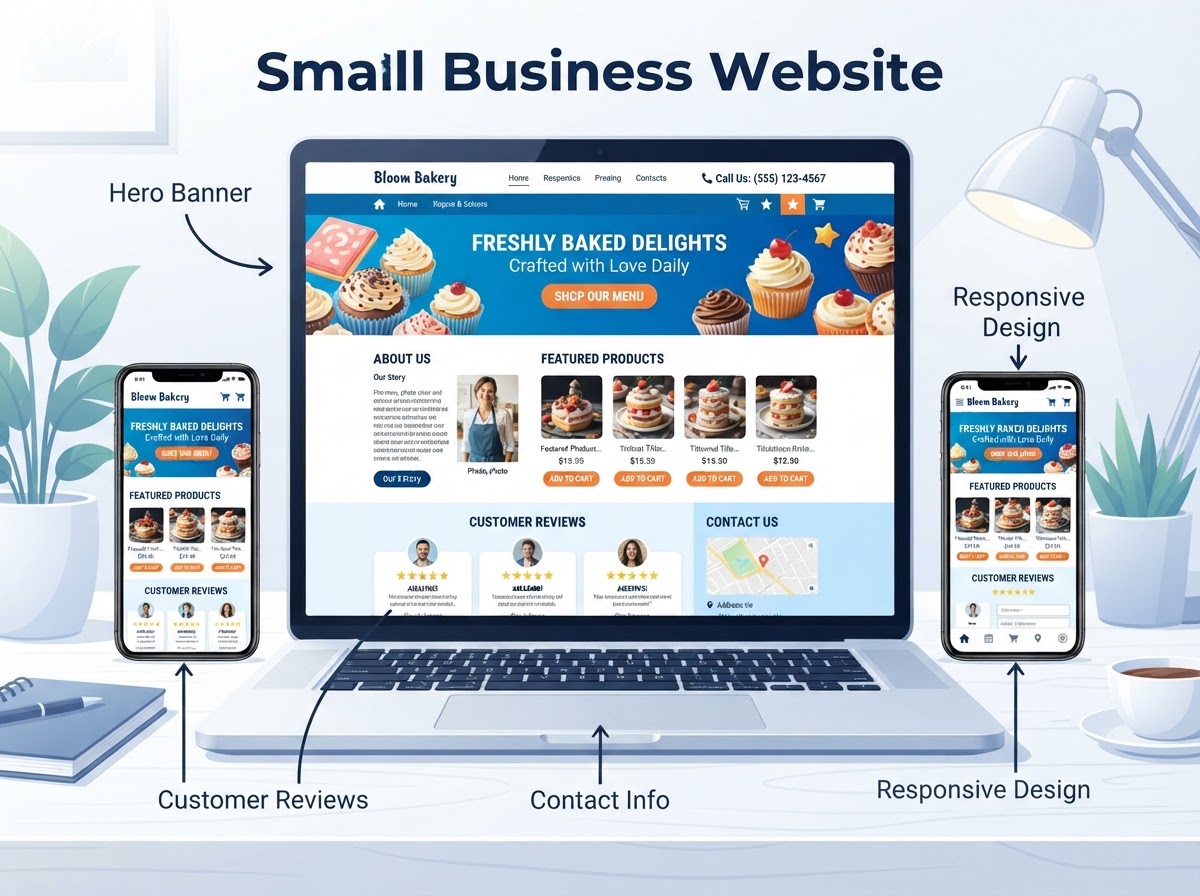

You're about to build a website for your small business — or rebuild the one that's been sitting there for years. Before you spend a dollar, you need to know what actually goes on a site that generates leads versus one that just takes up space on the internet.
Here's the list of non-negotiables — the elements that separate a website that works from a website that exists.
What this post answers:
- The 3 jobs every small business website must do
- The 5 non-negotiable elements your site needs in 2026
- What most small business websites are still missing
- How to tell if your current site is doing its job
The 3 Jobs Every Small Business Website Must Do
Before we get to specific elements, it helps to understand what your website exists to do. A small business website has three jobs:
- 1.Get found by people searching for what you offer
- 2.Convince those people you're the right choice
- 3.Make it easy for them to contact you
If your website fails at any one of these, it's not working. A site that gets found but doesn't convert is just a billboard. A site that converts but nobody visits is a store with no door. A site that people find and like but can't figure out how to contact is a missed opportunity.
Your website's job isn't to look impressive — it's to generate phone calls, emails, and bookings.
Non-Negotiable 1: A Clear, Specific Value Proposition Above the Fold
"Above the fold" means what a visitor sees without scrolling. This is the most valuable real estate on your entire website. The first thing a visitor's eyes land on should answer two questions: what you do and who you do it for.
"We provide quality service with a commitment to excellence" says nothing. "We build websites that generate leads for Michigan contractors" tells them exactly what they need to know in one sentence.
The difference between a generic value proposition and a specific one isn't style — it's whether the visitor understands if you can help them. A specific value proposition filters out the wrong visitors and signals to the right ones that they're in the right place.
If a stranger can't figure out what you do and whether you can help them in under five seconds, your value proposition isn't working.
Non-Negotiable 2: A Mobile-First Design (60%+ of Your Traffic Is Mobile)
More than 60% of local business searches happen on a phone. Google uses mobile-first indexing, which means Google looks at the mobile version of your site first to determine your rankings. If your mobile experience is bad, your desktop version doesn't matter.
What "mobile-first" actually means in practice:
- Text is readable without pinching to zoom
- Buttons are large enough to tap with a thumb
- The phone number is one tap to call
- The site loads in under 2.5 seconds on mobile data
If your site looks great on a laptop but falls apart on a phone, you're losing more than half your potential customers before they ever read a word.
Non-Negotiable 3: One Primary CTA, Not Six
A call-to-action (CTA) is the button or link that tells a visitor what to do next. The most common mistake on small business websites is giving visitors too many options.
"Call us! Or email us! Or fill out this form! Or follow us on Facebook! Or check our blog! Or download our free guide!" — when you give a visitor six things to do, they do none of them.
Pick one primary action — usually "Call Now" or "Get a Free Quote" — and make it the obvious next step on every page. The button should be large, a contrasting color, and positioned where the eye naturally lands. Secondary actions like social media links or newsletter sign-ups belong in the footer, not competing with your main button.
Every page on your website should have exactly one clear next step — not a menu of options, but a single, obvious action.
If you're not sure what your primary CTA should be, start with what generates the highest-value customer. For most service businesses, that's a phone call. Make the number prominent, tappable, and impossible to miss. Everything else is secondary.
Non-Negotiable 4: Your Real Phone Number, Clickable
This sounds too simple to be a "non-negotiable," but a shocking number of small business websites bury the phone number in a tiny footer font, put it inside an image (which can't be tapped), or omit it entirely on mobile.
On a phone, your number should be a tel: link — one tap opens the dialer. On desktop, it should be prominently displayed in the header. Not in the footer. Not on a separate contact page. In the header, on every single page.
When someone searches for a service on their phone and lands on your site, they're often ready to call right then. If they have to pinch-zoom to find your number or copy-paste it into their dialer, most won't bother. They'll hit the back button and call the next business in the results.
If a mobile visitor has to pinch-zoom, copy, and paste your phone number into their dialer, you've already lost them.
Non-Negotiable 5: Proof That You're Legit (Reviews, Portfolio, About)
When someone lands on your website, they're evaluating whether to trust you. In 2026, trust signals aren't optional — they're the difference between a call and a bounce. The three proof elements every small business site needs:
Real, linked reviews from Google or Yelp beat generic "great service!" testimonials any day. If you have 50 Google reviews, surface that number and a few actual review snippets on your homepage. Research from BrightLocal's consumer survey consistently shows that most consumers read reviews before they ever pick up the phone.
Show your work. If you're a contractor, show before-and-after photos. If you're a designer, show screenshots. The question "can they actually do this?" gets answered before they ever contact you.
People hire people, not logos. An About page with a real photo, a real name, and a real story builds more trust than a mission statement ever will.
A visitor who can see proof that you deliver is a visitor who picks up the phone. A visitor who can't is a visitor who hits the back button.
What Most Small Business Websites Are Still Missing in 2026
Even sites that have the five non-negotiables are often missing the things that separate a good website from one that actually generates leads:
Your city, your service area, and your industry in your page titles, headings, and content. Without these, Google doesn't know who to show you to.
Structured data that tells Google exactly what your business is, where you are, and what you offer. It's invisible to visitors but critical for search and AI visibility.
Google's Core Web Vitals standard requires your largest page element to load in under 2.5 seconds. Most small business sites miss this — and Google ranks them lower because of it.
Most visitors aren't ready to call the moment they land. A system that captures their email and follows up automatically turns "browsers" into future customers.
For Michigan businesses, this matters more than most. Grand Rapids alone has 31 web design agencies competing for the same local searches. The businesses that win are the ones whose sites do all five non-negotiables plus these four upgrades — not the ones running a template that checks two out of nine. Whether you're a contractor in Grand Rapids, a practice on Lansing's medical corridor, or a retailer in Detroit, the businesses getting the calls are the ones whose websites actually do the job.
The gap between a website that looks fine and a website that generates leads is the difference between these nine elements being present and being done right.
If you want to see how your current site measures up, professional web design for small businesses starts with an audit — not a pitch. We'll tell you exactly which of these nine elements you have, which you're missing, and what it's costing you each month.
Frequently Asked Questions
What does a small business website need to include?
A small business website needs five non-negotiable elements: a clear value proposition that tells visitors what you do and who you do it for, a mobile-first design that works on phones, one primary call-to-action on every page, a clickable phone number that's easy to find, and proof elements like reviews, portfolio examples, and a real About page. Beyond the basics, your site also needs local SEO signals, schema markup, fast load times, and a follow-up system to capture visitors who aren't ready to call yet.
How many pages does a small business website need?
Most small business websites need 5–10 pages: a homepage, a services page, an about page, a contact page, and individual pages for each major service you offer. The exact number depends on how many services you provide and how much there is to say about each one. A one-page website can work for a single-service business, but most service businesses need separate pages to rank for different search terms.
What is the most important part of a small business website?
The most important part is what a visitor sees above the fold — the first thing on their screen without scrolling. If your value proposition, phone number, and call-to-action aren't visible in the first three seconds, nothing below them matters. A visitor who doesn't understand what you do or how to contact you in the first five seconds will leave.
Does my small business website need to be mobile-friendly?
Yes — non-negotiably. More than 60% of local business searches happen on phones, and Google uses mobile-first indexing, meaning it evaluates the mobile version of your site first for rankings. A site that doesn't work well on mobile loses more than half its potential customers and ranks lower in search results.
What should be on the homepage of a small business?
A small business homepage needs a clear headline that states what you do and who you serve, a visible phone number or call-to-action button above the fold, social proof like reviews or client logos, a brief summary of your services with links to detail pages, and a way to contact you. Everything else is optional. If your homepage doesn't have these five things, it's not doing its job.
Do I need reviews on my business website?
You don't technically need reviews on your site to function, but you absolutely need them to convert. Research from BrightLocal's consumer survey consistently shows that most consumers read reviews before contacting a local business. Surfacing real, linked reviews from Google or Yelp on your homepage and service pages builds trust faster than any other element on your site.
Not Sure If Your Website Has What It Needs?
Get a free growth audit and we'll tell you exactly which of these nine elements your site has, which it's missing, and what it's costing you each month.
Get Your Free Growth Audit